
- Check air pressure in all your tyres, including the spare, once every week preferably from the same outlet. Tyres should be cold when checking pressure. Drive to an outlet, preferably when the tyres are cold. Maintaining proper air pressure will ensure good fuel economy & a longer life of the tyres.
- Rotate your tyres every six months or say 10000 kilometers distance covered or whichever comes first. Rotation should be simple. Front left should move to rear left and this tyre should move to front left position. Similar is the case with the right side.
- Align your wheels every six months. Due to ruts and even protruding “cats eyes” alignment gets disturbed and tyre will wear out faster from any one side. Fuel economy will reduce.
- Purchase well known brands that carry warrantee. It is better to buy once and cry once than to keep crying when you go for used or very cheap tyres with no warranty.(Used tyres have hidden injuries which are repaired & disguised. Such tyres can cause serious blow outs while driving.)
- Never buy a used tyre whose history you do not know.
- Never reduce air pressure when traveling long distance as this will generate more rolling resistance, more heat and could result in a blow out. Remember heat is the worst enemy of tyre.
- Never purchase bigger or heavier tyres as they add weight to the rims, increasing fuel consumption and possibly damaging the suspension.
- Never buy low aspect ratio tyres (i.e tyres with small heights or sidewalls) as such tyres are very hard and will ruin your suspension unless the car manufacturer puts in such tyres as original equipment.
- For our roads and climatic conditions purchase tyres that are not too soft and neither too hard as such tyres will give longer life.
DO’S & DONT’S
TYRE CARE TIPS FOR PASSENGER CAR TYRES
“CARE FOR YOUR TYRES AS THEY CARE FOR YOU”
AIR PRESSURE
Correct level of tyre pressure is vital. Consult your owners manual about the required pressure recommended by the manufacturer and get the inflation checked at regular intervals, preferably from same filling station. While driving on highways or motorways at higher than normal speeds, ensure that your tyres have approx. 3 PSI more pressure than normal. Revert back to normal pressure in the city
ROTATION
It is necessary to rotate the tyres after every I 0,000 kilometers for even wear and longer life.
BALANCING
Always get your tyre/wheel assembly dynamically balanced for a comfortable and smooth ride. Wheel Alignment Mis- Aligned tyre leads to higher fuel consumption, less driving comfort. Check wheel alignment every six month.
DRIVING HABITS
Drive consistently, accelerate and brake gradually and smoothly.
UNDERSTANDING TYRE
TYRE CONSTRUCTION
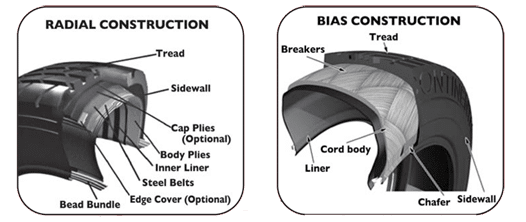
Tyres are classified according to their construction as: 1 – Radial. 2 – Bias or Diagonal or Cross Ply.
RADIAL CONSTRUCTION
In Radial tyre, ply cord, either steel or fabric, run straight across the tyre from bead to bead. In addition, the radial tyre has a belt of additional plies, usually steel running down the centre of the tyre between the carcass and the tread. This construction allows the radial sidewall to be much more flexible while the tread is much stiffer than bias ply tyres.This allow the tyre to absorb impacts and limit sideways movement of the tread while cornering.
BIAS CONSTRUCTION
In the Bias ply tyre, also known as diagonal ply tyre, plies run from bead to bead at an angle (hence the name bias).With layers of plies criss-crossing each other.This construction makes the sidewall relatively stiffer and the tread area softer.
KNOWING YOUR TYRE
You may wish to know what size tyre you use.You can get the tyre’s size by reading the side wall. The Numbers / Lettering stands for: 195 = Width of the tyre in millimetres 65 = Height of the tyre sidewall as a percentage of the width Also known as the aspect ratio R = Radial Construction 15 = The diameter of the wheel 91 = Load Capacity of Tyre H = Speed Symbol. Indicates the max. speed (210 kph) for the tyre at full load.
TYRE LOAD RANGE |
|
| Load Range & Ply Rating | |
| A | 2 Ply Ratings |
| B | 4 Ply Ratings |
| C | 6 Ply Ratings |
| D | 8 Ply Ratings |
| E | 10 Ply Ratings |
| F | 12 Ply Ratings |
| G | 14 Ply Ratings |
| H | 16 Ply Ratings |
| J | 18 Ply Ratings |
TYRE SPEED RATINGS |
|
| Rating for KM Per Hour | |
| P | Up to 150 kmph |
| P | Up to 150 kmph |
| Q | Up to 160 kmph |
| R | Up to 170 kmph |
| S | Up to 180 kmph |
| T | Up to 190 kmph |
| U | Up to 200 kmph |
| H | Up to 210 kmph |
| V | Up to 240 kmph |
| W | Up to 270 kmph |
| Y | Up to 300 kmph |
| ZR | Over 250 kmph |
LOAD CARRYING CAPACITY |
|
| Load Index | Load Carrying Capacity (Kgs) |
| 69/73 | 325/365 |
| 74/75 | 375/387 |
| 77/79 | 412/437 |
| 82/83 | 475/487 |
| 84/86 | 500/530 |
| 89/91 | 580/615 |
| 100/102 | 800/850 |
| 104/106 | 900/950 |
| 114/116 | 1180/1250 |
Last updated on: October 07, 2025
Copyright : © 2025 GTR TYRES.